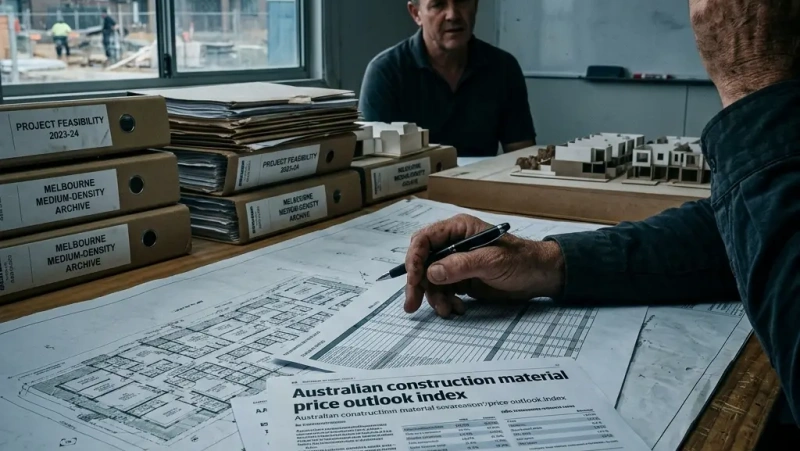
Australia’s Housing Crisis Is Structural, Not Cyclical: A Developer’s View

Australia’s residential development market is under structural stress, not cyclical pressure. Construction costs, regulatory burdens, and recent tax changes have combined to make development unfeasible for small to medium developers in most locations. The only viable segment right now is high-quality, owner-occupier product in premium suburbs. Without a deliberate policy decision to shift infrastructure costs off the sale price of a home, affordability will continue to deteriorate.

Lessons From 40 Years: Navigating Builder Insolvency Risk in a High-Cost Environment

Australia’s construction sector is facing a cost crisis, not a recession. Traditional due diligence overlooks the real risk. The counterintuitive move, keeping cash flowing to a distressed builder, is often the cheapest decision a developer can make.
• Builder insolvency signals are harder to interpret today because costs are rising in a functioning economy, not during a downturn.
• Fixed-price contracts signed before 2022’s cost surge are still causing hidden losses that don’t appear in a builder’s financial history.
• Standard due diligence cannot detect contagion risk from disputes on other projects that drain your builder’s cash.
• Withholding payment when a builder wobbles usually accelerates the collapse that developers are trying to prevent.
• Overpaying a distressed builder to reach completion is often the lowest-cost option.

Governance Checklist for Australian Developers: Consultant Agreements & Risk Allocation

Most first-time Australian developers sign consultant agreements without understanding what they’re agreeing to. The clauses that look like standard boilerplate, such as liability caps, payment terms, copyright provisions, and termination rights, are where your financial exposure is set. Bring your own pro forma agreement, understand basic risk allocation, and you’ll govern your project. Sign whatever arrives, and you’re already behind.

Build-to-Rent Is Not a Housing Solution. It’s a Tax Product That Dismantles Private Wealth

The Australian government promotes Build-to-Rent (BTR) as a solution to Australia’s housing affordability crisis. It is not. BTR is a tax-advantaged financial product that systematically transfers residential property wealth from private Australian individuals to institutional capital. The 2026-27 Federal Budget accelerated this transfer by stripping away tax tools for individual investors whilst preserving and expanding institutional advantages. Working-class Australians are the primary casualties.

Why Australian Property Projects Fail: The Consultant Incentive Problem Explained

Australian property consultants optimise for billable hours, deliverable volume, and engagement duration. Meanwhile, 69% of construction projects fail to deliver on budget because no one optimised for the outcome you hired them to deliver: structural correctness at inception. The consultants aren’t incompetent. The incentive structure is broken.

Which Australian Property Developments Collapse First in a Recession? The 25% Margin Rule

Property developments with margins below 25% return on cost will collapse first in a recession. Revenue declines occur before cost escalation becomes visible. Developers who acquired projects in 2023-2024 with thin margins face collapse in 2026 as construction costs climb 5% annually, interest rates rise to 4.35%, and buyer confidence evaporates. The structural weakness is present at inception, not when market conditions deteriorate.

Why Independent Market Research Reports Are Non-Negotiable for Medium-Density Residential Development

Revenue projections ruin more medium-density residential projects than construction cost overruns. Agents inflate figures for commissions. Valuers undervalue for lender protection. Only commissioned independent market research reports balance opposing biases to provide the reliable figures financiers rely on. Over 40 years in property development, I’ve seen developers repeat the same revenue errors.

Property Developer Failure: Why Technical Skills Without Strategic Foresight Cost You Everything

Technical expertise in construction, architecture, or project management won’t save your property development project if you’re addressing the wrong problem. After 40 years in the industry, I’ve seen brilliant builders fail because they focus on execution while overlooking strategic threats developing on the horizon. Foresight surpasses precision. The developers who succeed in the next decade will be those who observe market signals, anticipate shifts, and position themselves proactively before breaking ground.